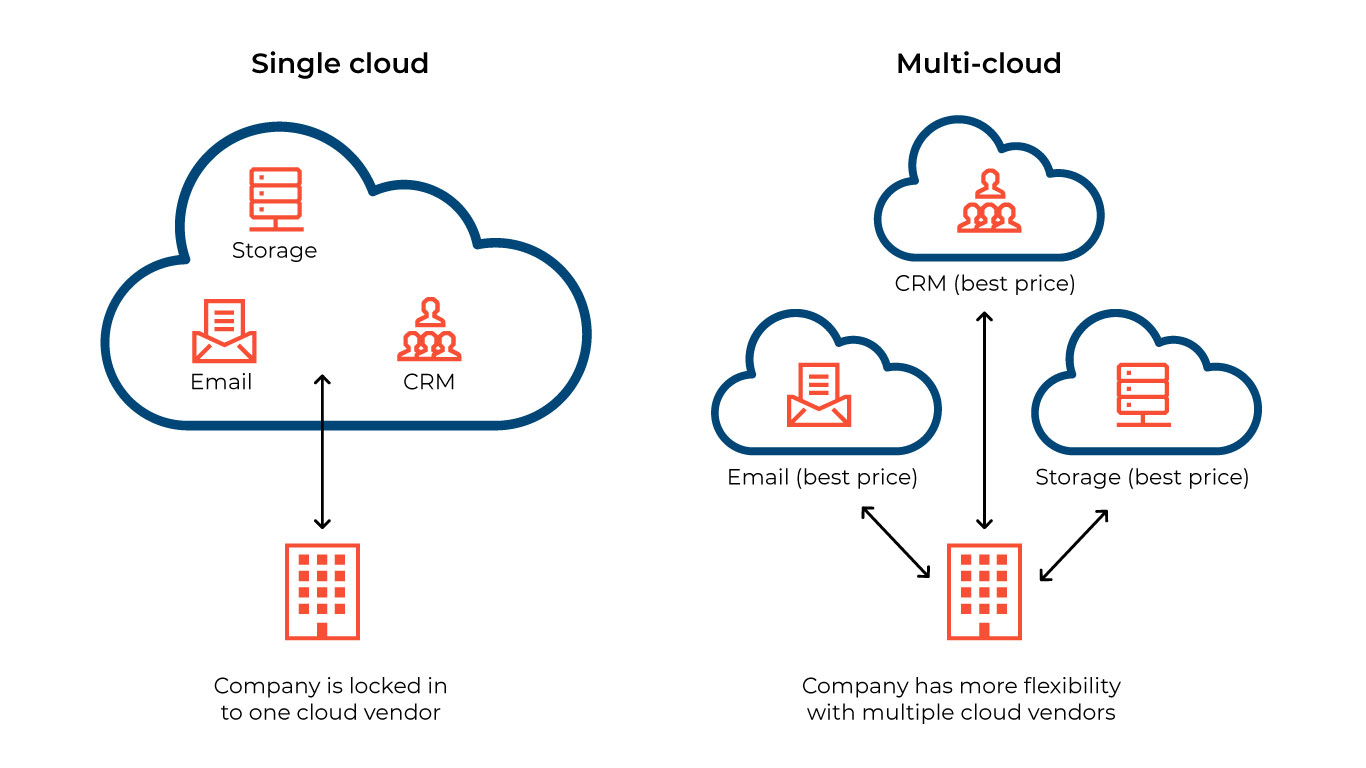
As organizations accelerate digital transformation, relying on a single cloud provider is no longer the default approach. Many enterprises are adopting a multi-cloud strategy — using services from two or more public cloud providers — to improve resilience, flexibility, and performance.
Multi-cloud is not just a technical choice; it is a strategic business decision that affects cost, security, operations, and innovation. This comprehensive guide explains what multi-cloud is, why organizations adopt it, its benefits and challenges, and how to implement it successfully.
WHAT IS A MULTI-CLOUD STRATEGY?
A multi-cloud strategy involves using cloud services from multiple providers such as Amazon Web Services (AWS), Microsoft Azure, and Google Cloud Platform (GCP). Organizations distribute workloads, applications, or data across these platforms instead of relying on a single vendor.
Multi-cloud may include:
• Running different applications on different providers
• Using specialized services from multiple clouds
• Deploying the same application across clouds for redundancy
• Splitting workloads by geography or business unit
Multi-Cloud vs Hybrid Cloud:
Multi-Cloud refers to multiple public cloud providers, while Hybrid Cloud combines private/on-premise infrastructure with public cloud.
WHY BUSINESSES ADOPT MULTI-CLOUD
Key drivers include:
• Avoiding vendor lock-in
• Improving business continuity
• Meeting regulatory requirements
• Optimizing costs
• Accessing best-of-breed services
• Enhancing global performance
• Supporting mergers or acquisitions
KEY BENEFITS OF MULTI-CLOUD
1) Reduced Vendor Lock-In
Organizations maintain flexibility and negotiating power while avoiding dependence on a single provider.
2) Higher Availability and Resilience
Multi-cloud reduces single points of failure and supports disaster recovery across providers.
3) Best-of-Breed Services
Each provider excels in different areas such as AI, analytics, or compute optimization.
4) Performance Optimization
Deploying workloads closer to users improves latency and user experience.
5) Cost Optimization
Workloads can be placed where pricing is most favorable, improving overall efficiency.
6) Regulatory Compliance and Data Sovereignty
Multi-cloud helps organizations store data in compliant regions and meet industry regulations.
CHALLENGES OF MULTI-CLOUD
1) Operational Complexity
Managing multiple platforms increases administrative overhead and requires sophisticated processes.
2) Security Management Difficulties
Maintaining consistent security policies across providers is challenging and requires unified controls.
3) Skills Gap
Specialized expertise is needed for each platform, increasing training and hiring requirements.
4) Data Transfer Costs and Latency
Moving data between clouds can incur significant egress fees and performance issues.
5) Governance and Compliance Challenges
Ensuring consistent policies, audits, and reporting across environments is complex.
6) Monitoring and Visibility Issues
Without centralized tools, performance problems and outages may go unnoticed.
MULTI-CLOUD IMPLEMENTATION GUIDE
Step 1: Define Business Objectives
Clearly identify goals such as risk reduction, cost optimization, or global expansion.
Step 2: Assess Existing Workloads
Evaluate applications based on performance needs, sensitivity, dependencies, and compliance requirements.
Step 3: Choose the Right Providers
Select providers based on strengths, regional presence, pricing, certifications, and integration capabilities.
Step 4: Design the Architecture
Plan workload placement, networking, identity management, data replication, and disaster recovery.
Step 5: Implement Unified Management Tools
Use centralized platforms for monitoring, automation, security, and cost management.
Step 6: Establish Security and Governance Frameworks
Adopt Zero Trust principles, centralized identity systems, encryption, and continuous compliance monitoring.
Step 7: Optimize and Monitor Continuously
Regularly review performance, costs, capacity, and security posture.
INDUSTRIES THAT BENEFIT MOST
Multi-cloud is especially valuable for:
• Banking and financial services
• Healthcare and life sciences
• Government agencies
• Telecommunications
• Global enterprises
• E-commerce platforms
• Technology companies
WHEN MULTI-CLOUD MAY NOT BE IDEAL
Multi-cloud may be excessive for small businesses, startups seeking simplicity, or organizations lacking cloud expertise.
FUTURE OF MULTI-CLOUD
Adoption is expected to grow with trends such as AI-driven cloud management, cross-cloud automation, platform engineering, and edge computing integration.
FINAL THOUGHTS
A well-implemented multi-cloud strategy can deliver resilience, flexibility, compliance, and performance advantages. However, success requires strong governance, skilled teams, robust architecture, and continuous optimization.
When aligned with business objectives, multi-cloud becomes a powerful enabler of innovation and long-term growth in the digital era.