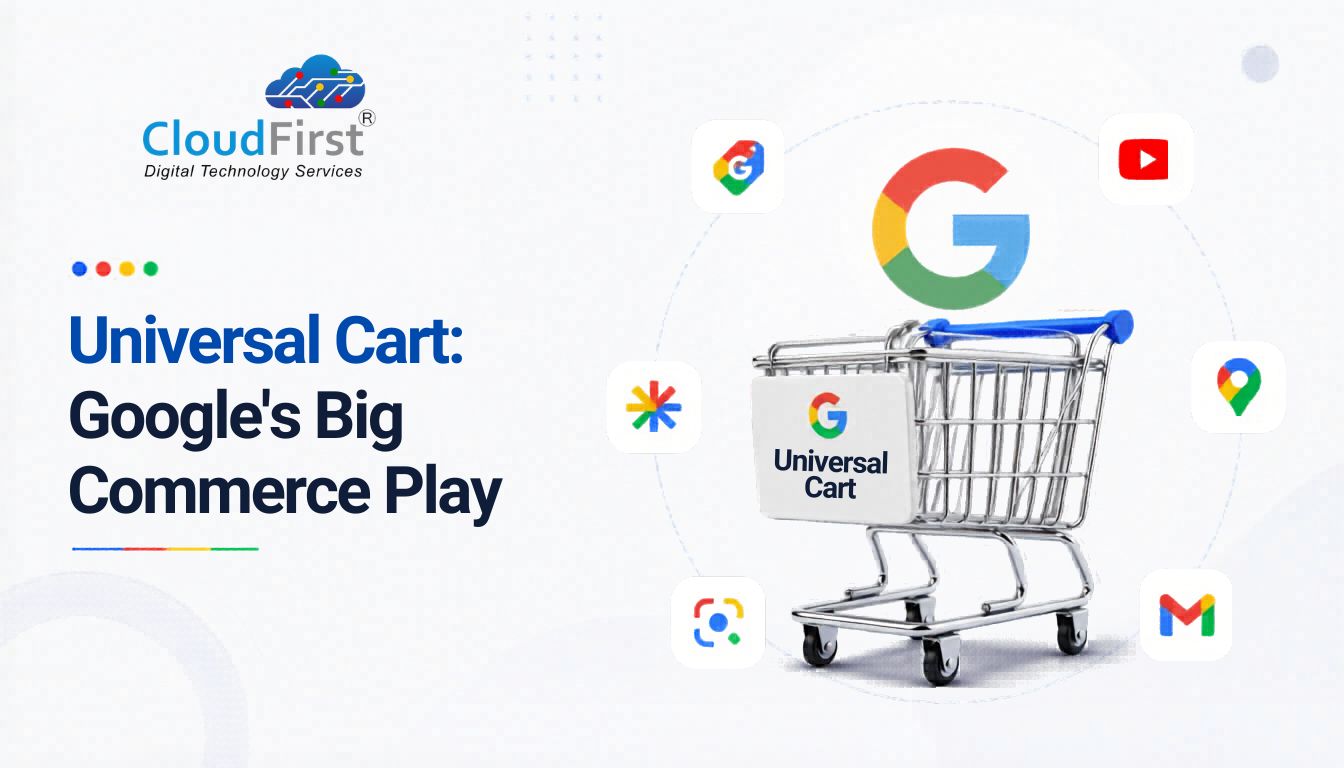
Google doesn’t just want to help users search anymore. It wants to help them buy, instantly, intelligently, and entirely within its own ecosystem.
At Google I/O 2026, the company unveiled Google Universal Cart: an AI-powered, cross-platform shopping system that unifies product discovery and checkout across Google Search, Gemini, YouTube, and Gmail. This isn’t a minor feature update. It’s one of the most significant shifts in ecommerce infrastructure since mobile shopping went mainstream.
Here’s everything you need to know.
What Is Google Universal Cart?
Google Universal Cart is an intelligent, centralised shopping cart that follows users across Google’s entire product suite. Instead of bouncing between retailer websites, creating multiple accounts, and managing separate checkouts, shoppers can now add items to a single cart — from any Google surface — and manage everything in one place.
The feature was announced at Google I/O 2026 and is built on top of Google’s Universal Commerce Protocol (UCP), a shared infrastructure layer that connects product discovery, checkout, payments, and AI agents into one seamless commerce ecosystem.
Key facts at a glance:
- Google’s Shopping Graph now contains 60 billion+ product listings
- People shop across Google more than 1 billion times per day
- Universal Cart launches first in the US on Google Search and the Gemini app (summer 2026), with YouTube and Gmail to follow
How Google Universal Cart Works
Cross-Platform Shopping in One Cart
Universal Cart works across four major Google platforms:
Google Search — Users can add products directly from search results without visiting a retailer’s website. This keeps the entire discovery-to-intent journey inside Google.
Gemini (AI Assistant) — Shoppers can chat with Gemini, get AI-assisted product recommendations, and add items to their cart mid-conversation. This is where agentic commerce truly begins.
YouTube — While watching product reviews, unboxing videos, or tutorials, users can save items directly to their Universal Cart without leaving the video.
Gmail — Promotional emails and deal alerts now have a direct pipeline to the cart. Users can collect items from their inbox without switching apps.
AI-Powered Intelligence in the Background
The moment a product is added to the cart, Google’s AI goes to work:
- Tracks price drops and deal alerts automatically
- Surfaces price history so users can spot a genuine discount
- Sends back-in-stock notifications for out-of-stock items
- Flags product compatibility issues before purchase
- Aggregates loyalty offers and merchant discounts via Google Wallet
Frictionless Checkout via Google Pay and UCP
Checkout happens either directly through Google Pay — using saved payment methods and loyalty programmes — or by transferring the cart to the merchant’s own website. Google’s Universal Commerce Protocol (UCP) is the infrastructure layer that makes this cross-retailer, cross-platform checkout technically possible. Retailer adoption of UCP is already growing ahead of the public launch.
Why Google Universal Cart Matters for SEO and Ecommerce
The Search Journey Is Changing — Permanently
Google Universal Cart is part of a broader shift from keyword-based search to intent-based, agentic search. Users are already asking longer, more conversational shopping queries:
- “Best lightweight laptop under $1,000 for travel and video editing”
- “Fragrance-free skincare for dry sensitive skin under $30”
Google’s AI needs to understand product features, pricing, reviews, availability, use cases, and compatibility — not just match keywords. This has major implications for how products get discovered in 2026 and beyond.
Google Merchant Center Optimisation Is Now More Critical Than Ever
With Universal Cart pulling product data directly into AI-powered surfaces, Merchant Center feed quality is no longer just a Shopping ads concern — it’s a core SEO signal. Google’s AI recommendation engine weighs:
- Feed data completeness and accuracy
- Pricing competitiveness
- Structured data richness (schema markup)
- Review credibility
- Delivery reliability
Brands that invest in clean, detailed, up-to-date product feeds will have significantly better visibility across Search, Gemini, YouTube, and Gmail. Those that don’t risk being invisible to the AI entirely.
Traditional Attribution Is Breaking Down
When Google manages the cart and checkout flow, retailers lose direct visibility into purchase intent signals and conversion paths. Click-through rates, session data, and on-site behaviour metrics will become harder to track. Businesses need to prepare for:
- New attribution models that account for Google-mediated checkout
- First-party data strategies that reduce reliance on Google’s conversion data
- UCP integration on their technical roadmap to stay eligible for Universal Cart placement
The SEO Playbook Is Shifting Toward GEO
Google I/O 2026 marks a clear acceleration toward Generative Engine Optimisation (GEO) — where content must be structured, factually trustworthy, and easy for AI systems to extract, cite, and act on. The old formula of keyword density, backlink profiles, and domain authority still matters for informational content. But for ecommerce specifically, the decision about which products appear in AI recommendations is made on entirely different logic.
Brands with strong structured data, expert-led content, accurate product feeds, and consistent information across the web are best positioned to win in this new environment.
What This Means for Retailers and Marketplaces
Google has been careful to frame its position clearly. As Google Commerce’s Ashish Gupta stated: “We are not a retailer, we are not a marketplace — and that approach continues to guide us in this agentic era as well.”
But the practical reality for retailers is more complex:
The opportunity: Access to 60 billion+ product listings, reduced cart abandonment, and reach across Search, Gemini, YouTube, and Gmail — all from a single product feed.
The challenge: Google is consolidating more of the shopping journey inside its own platforms. Discovery, comparison, cart management, and checkout are increasingly happening without the shopper ever visiting a retailer’s website.
The risk: Customer relationships and data are being mediated by Google’s AI. As Wharton marketing professor Kartik Hosanagar put it: “Whoever controls the agents now has the power.”
Competitors are responding: Amazon and TikTok are both investing heavily in their own checkout flows and commerce experiences. Universal Cart accelerates the platform war for the purchase moment.
How to Prepare Your Business for Google Universal Cart
- Audit your Google Merchant Center feed — ensure product titles, descriptions, images, pricing, and availability are accurate and complete
- Implement structured data (schema markup) — product schema, review schema, and offer schema are essential for AI-readable product pages
- Integrate with Universal Commerce Protocol (UCP) — get this on your 2026 technical roadmap
- Shift to intent-based content — create content that answers complex, conversational shopping queries, not just short-tail keywords
- Build first-party data infrastructure — prepare for a world where Google-mediated checkout reduces your direct attribution signals
- Optimise for AI visibility, not just page rankings — think feed quality, brand trust signals, review volume, and pricing competitiveness
The Bottom Line
Google Universal Cart isn’t just a new shopping feature. It’s the infrastructure layer for the next era of ecommerce, one where AI agents discover, compare, manage, and complete purchases on behalf of users, largely within Google’s own ecosystem.
For cloud-first businesses and ecommerce brands, the message is clear: the checkout experience is being rebuilt from scratch. Structured data, feed quality, and UCP readiness are the new SEO. The brands that adapt early will capture the lion’s share of AI-driven commerce. The ones that don’t will find themselves invisible to the systems making purchase decisions on their customers’ behalf.
The battle for checkout isn’t about payments. It’s about who owns the moment of intent, and Google just made its biggest move yet.