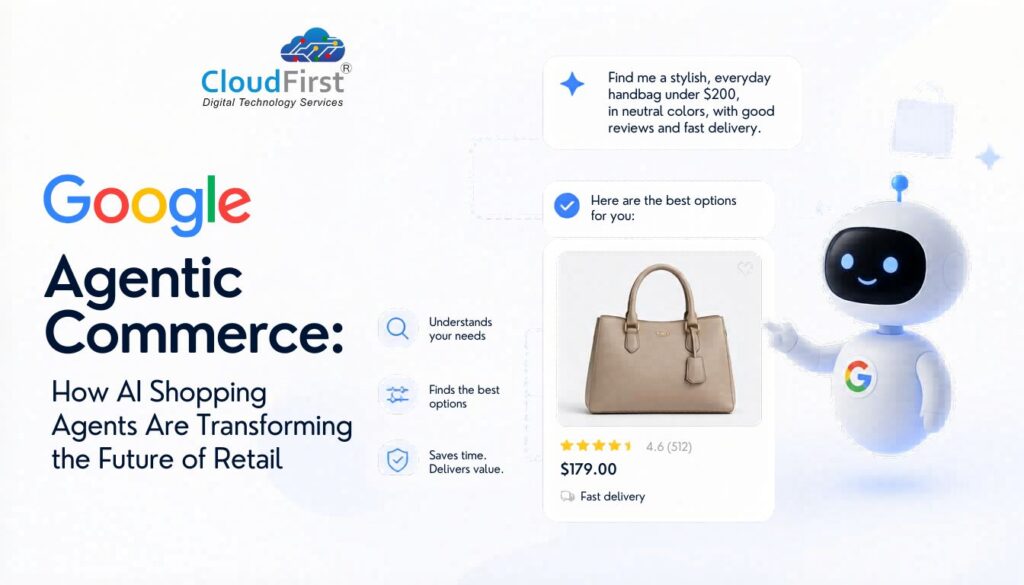
Google’s AI Commerce Vision Could Redefine Online Shopping
Google’s latest announcements at Google I/O 2026 introduced a major shift in the future of digital commerce — the rise of Agentic Commerce.
Powered by advanced AI shopping agents, this new approach to online retail could completely transform how customers discover products, compare options, and complete purchases.
For businesses, retailers, startups, and cloud providers, this is more than just another AI trend.
It represents the beginning of a new era where AI systems actively participate in customer buying journeys.
As artificial intelligence becomes deeply integrated into commerce, companies will need scalable cloud infrastructure, AI-ready systems, and real-time automation to remain competitive.
What Is Agentic Commerce?
Agentic Commerce refers to AI-powered shopping experiences where intelligent agents assist users throughout the purchasing process.
Instead of manually browsing websites and comparing products, users can rely on AI systems to:
- Understand shopping intent
- Compare products instantly
- Analyze reviews and pricing
- Recommend the best options
- Personalize buying decisions
- Automate checkout experiences
This creates a smarter and faster shopping experience powered by artificial intelligence.
Google’s new open standards and AI commerce tools indicate that the company is building the foundation for this next-generation retail ecosystem.
How AI Shopping Agents Work
Traditional e-commerce relies heavily on manual actions.
Customers typically:
- Search for products
- Open multiple tabs
- Compare reviews
- Check pricing
- Evaluate features
- Complete purchases manually
AI shopping agents simplify this entire process.
For example, a user may ask:
“Find the best business laptop under ₹80,000 with strong battery life and AI capabilities.”
An AI shopping assistant could then:
- Analyze product specifications
- Compare prices across platforms
- Review customer ratings
- Track discounts
- Recommend the best match
- Complete the checkout process
This creates a highly personalized and efficient customer experience.
Why Google’s Agentic Commerce Strategy Matters
Google dominates online search and digital discovery.
By integrating AI-powered shopping agents into search and commerce experiences, Google is reshaping how customers interact with online retailers.
This shift could impact:
- E-commerce platforms
- Online marketplaces
- Retail advertising
- Product discovery
- Digital marketing strategies
- Customer engagement models
Businesses that optimize for AI-driven commerce early could gain a major competitive advantage.
The Future of Retail Is AI-Driven
AI-powered retail experiences are becoming more intelligent and automated.
In the future, AI agents may:
- Monitor customer preferences continuously
- Predict purchasing behavior
- Recommend products proactively
- Optimize pricing dynamically
- Automate reordering processes
- Deliver hyper-personalized experiences
This transition reduces friction in online shopping and improves customer satisfaction.
As customer expectations evolve, businesses will need to deliver faster, smarter, and more personalized experiences.
AI Commerce Requires Scalable Cloud Infrastructure
One of the biggest drivers behind AI commerce is cloud infrastructure.
AI-powered retail systems require:
- High-performance computing
- Real-time data processing
- Scalable cloud environments
- GPU-powered workloads
- Fast APIs and integrations
- Intelligent automation systems
Without strong cloud infrastructure, businesses may struggle to support AI-native experiences.
This is why cloud optimization and AI-ready architecture are becoming critical for modern enterprises.
Organizations investing in scalable infrastructure today will be better positioned for the future of AI commerce.
What Agentic Commerce Means for Startups
The rise of AI commerce creates massive opportunities for startups.
Emerging companies can now build:
- AI shopping assistants
- Conversational commerce platforms
- Personalized recommendation engines
- Retail automation tools
- AI-powered customer support systems
- Intelligent buying platforms
As AI development tools become more accessible, startups can innovate faster and scale more efficiently.
The next generation of successful retail technology companies may be built entirely around AI-driven experiences.
How Agentic Commerce Will Impact Digital Marketing
AI-powered shopping changes how brands attract customers online.
Traditional digital marketing strategies focused on:
- SEO rankings
- Paid advertising
- Product listing optimization
- Marketplace visibility
But in an AI-assisted commerce ecosystem, businesses must also optimize for:
- Structured product data
- AI-readable content
- Real-time inventory systems
- Intelligent recommendation algorithms
- Conversational search experiences
This means SEO, content strategy, and customer experience optimization will continue evolving alongside AI technologies.
Google I/O 2026 Signals a Larger AI Transformation
Google’s announcements at I/O 2026 highlight a much bigger industry shift.
Artificial intelligence is no longer limited to chatbots or productivity tools.
AI is becoming an operational layer across:
- Search
- Retail
- Cloud computing
- Enterprise workflows
- Automation systems
- Customer experiences
Agentic Commerce represents the beginning of AI-orchestrated digital experiences.
The internet is gradually evolving from:
Search-driven interactions → AI-driven decision making
This transformation could redefine how businesses operate over the next decade.
Final Thoughts
Google’s push toward Agentic Commerce signals the future of AI-powered retail and digital experiences.
As AI shopping agents become more advanced, businesses will need:
- AI-ready infrastructure
- Scalable cloud environments
- Intelligent automation systems
- Faster digital experiences
- Real-time data capabilities
The companies that succeed in the AI commerce era will not simply adopt AI tools.
They will build intelligent ecosystems designed for automation, personalization, and scale.
The future of commerce is becoming autonomous, intelligent, and deeply connected to AI infrastructure.
And that future has already started.