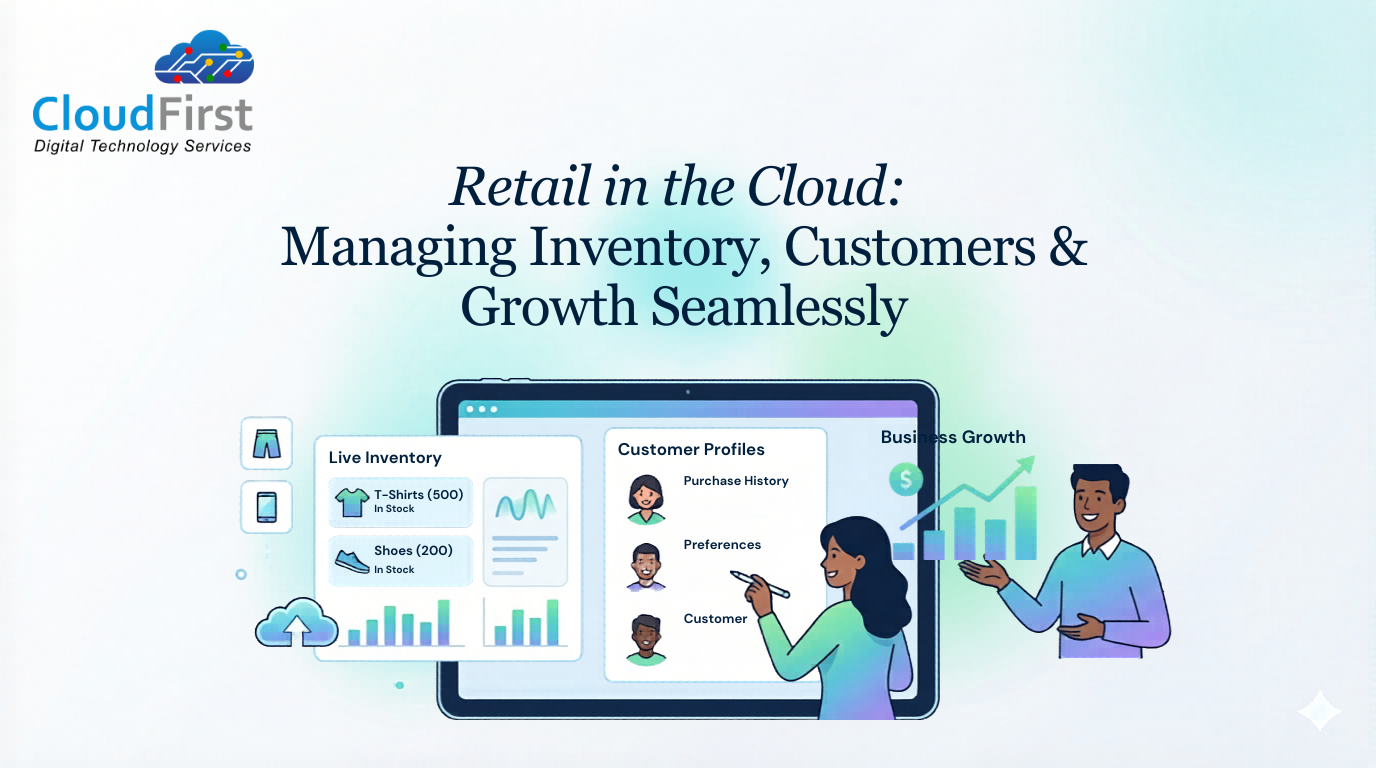
Picture this: It’s 11 PM on a Friday. A customer orders the last blue jacket in your store’s inventory — but your system doesn’t know it was just sold in-person two hours earlier. By morning, you have an angry customer, a refund to process, and a reputation bruise that could have been entirely avoided.
This is the reality for thousands of retailers still running on legacy, siloed systems. Cloud-based retail management was built precisely to eliminate this problem — and dozens more like it. In this guide, we’ll walk through how cloud technology transforms inventory control, customer relationships, and long-term growth strategy for retail businesses of every size.
Table of Contents
- Why retail is moving to the cloud
- Real-time inventory management
- Knowing your customer better
- Scaling without the growing pains
- Choosing the right platform
- Getting started: a practical roadmap
1. Why Retail Is Moving to the Cloud — Fast
The retail industry is undergoing its most dramatic technological shift in decades. Consumers now expect seamless omnichannel experiences — browse online, buy in-store, return anywhere — and the infrastructure powering those experiences needs to be equally seamless behind the scenes. Legacy on-premise systems simply weren’t built for this world.
Cloud retail platforms solve this by giving every part of your business access to the same data, in real time. A sale in one store updates the website. A return processed at the counter reflects in your reports instantly. Your warehouse team, your marketing manager, and your store staff are all working from the same picture.
The core benefits retailers consistently report after moving to the cloud:
Real-time sync — Every sale, return, and reorder updates instantly across all channels and locations. No more overnight batch processing that leaves your data hours behind reality.
Accessible anywhere — Manage operations from any device, whether you’re on the store floor, traveling, or working remotely. Your entire business is a login away.
Elastic scalability — Handle seasonal traffic spikes or new store openings without buying new hardware or worrying about server capacity. Cloud infrastructure scales with demand automatically.
Built-in security — Encryption, automated backups, and compliance frameworks come standard. You get enterprise-grade protection without needing a dedicated IT department.
“Cloud isn’t a trend in retail anymore — it’s the baseline expectation for any business that wants to compete in the next five years.”
2. Real-Time Inventory Management: The End of Stockout Surprises
Inventory is the heartbeat of retail. Too much stock ties up capital and fills warehouses with products that aren’t moving. Too little means lost sales, disappointed customers, and scrambled reorders. Cloud-based inventory management gives retailers the visibility and control to get this balance right — consistently.
What changes when inventory moves to the cloud
The most immediate shift is that your inventory is no longer a number that gets updated at the end of the day or after a manual count. It’s a live reflection of reality. A sale in your Mumbai store reduces the available count on your website at the same moment. Your warehouse team sees it. Your buying team sees it. Everyone is working from the same, current truth.
This opens up capabilities that simply aren’t possible with disconnected systems:
- Automatic low-stock alerts triggered before you run out, giving you time to reorder
- Full visibility across every location from a single dashboard
- Barcode and RFID integration that updates stock on every scan without manual entry
- Automated purchase orders sent to suppliers when stock hits a reorder threshold
- AI-powered demand forecasting that accounts for seasonality, trends, and historical patterns
- Identification of dead stock so slow-moving products get addressed before they become a write-off
Smarter fulfillment across channels
For omnichannel retailers, cloud inventory also unlocks intelligent fulfillment logic. You can set rules like: always hold a buffer of units for in-store customers, route online orders to the nearest stocked location, or activate ship-from-store when the central warehouse runs low. This kind of dynamic allocation used to require expensive custom development. Modern cloud platforms handle it with configuration, not code.
The SEO angle most retailers overlook
There’s a less obvious reason to care deeply about inventory accuracy: search performance. When your products show as out of stock on your website or Google Shopping, search algorithms treat those listings as lower quality and deprioritize them. Better cloud inventory management — through smarter forecasting and cross-location fulfillment — keeps more products available more of the time, which quietly protects your organic rankings and improves the return on your paid search spend.
3. Knowing Your Customer Better Than They Know Themselves
Modern retail isn’t just about moving product — it’s about building relationships that keep customers coming back. Cloud-based customer management tools have democratized the kind of deep customer intelligence that used to require a dedicated data science team and a seven-figure technology budget.
The unified customer profile
Every interaction a customer has with your brand — browsing your site, buying in-store, contacting support, opening an email — generates data. The problem with traditional retail systems is that this data lives in separate places: one database for ecommerce, another for the POS, another for email marketing. Nobody has the full picture.
Cloud retail platforms bring all of this together into a single customer profile. You can see the complete history: what they bought, when, through which channel, at what price point, and how they responded to your last three promotions. That’s not just interesting — it’s the foundation of everything from personalized recommendations to proactive service.
Personalization that actually moves the needle
With a complete customer view, you can stop sending the same message to everyone and start communicating in ways that actually resonate:
- Promotions targeted based on what a customer has bought before and what they’ve been browsing
- Loyalty programs that automatically reward the behaviors you most want to encourage
- Re-engagement campaigns triggered when a previously regular customer goes quiet
- Product recommendations driven by real purchase patterns, not just “what’s popular”
- In-store staff equipped with customer history so they can have genuinely helpful conversations
Segmentation and lifecycle strategy
Not all customers are the same, and treating them that way is a missed opportunity. Cloud CRM tools allow you to segment your base using frameworks like RFM — Recency, Frequency, and Monetary value — giving you a clear picture of who your best customers are, who’s at risk of churning, and who’s bought once and has high potential for a second purchase.
The difference between a generic email blast and a well-segmented lifecycle campaign is typically a 3–5x improvement in engagement and a meaningful lift in repeat purchase rate. That’s not a small thing — repeat customers are almost always more profitable than new ones.
4. Scaling Without the Growing Pains
Growth is the goal — but growth without the right infrastructure turns into chaos fast. Cloud retail architecture fundamentally changes what it costs, in time and money, to expand your business.
Opening a new location used to be a project. Now it’s a task.
With traditional systems, opening a new store meant weeks of preparation: sourcing hardware, installing software, setting up a local database, migrating product data, and training staff on a system that might behave slightly differently from the one they already knew. It was expensive, slow, and error-prone.
Cloud removes most of that friction. A new location is provisioned in your existing platform — it inherits your product catalog, your pricing rules, your loyalty program, your reporting structure. Staff train on the same interface they already know. The new store is genuinely part of your operation from day one, not a satellite running on its own.
Consistency across every channel
As you grow, consistency becomes one of your most important brand assets. Customers who shop with you in multiple ways — online and in-store, across different locations — expect the same experience everywhere. Cloud platforms make this possible because everything is controlled from one place. A promotion you run goes live everywhere simultaneously. A price change updates across every channel at once. Your loyalty points work the same whether a customer is in Delhi or Dubai.
Making growth decisions with real data
One of the most underrated advantages of cloud retail is how it changes the quality of your expansion decisions. Rather than relying on gut feel or regional anecdotes, you can look at actual purchasing data to evaluate new markets. Which product categories over-index with customers in a target city? What’s the average order value from similar demographics? Cloud analytics answer these questions before you commit capital, not after.
Growing across borders
For retailers with international ambitions, cloud platforms handle a lot of the complexity that used to require expensive local customization: regional tax calculations, multi-currency support, local compliance requirements, and consolidated reporting across markets. Expanding geographically becomes a strategic decision rather than a technical project.
5. Choosing the Right Cloud Retail Platform
The market for cloud retail software is crowded, and not every platform is built for every type of business. Getting this decision right matters — switching platforms is painful. Here’s what to evaluate before you commit.
Integration ecosystem
A cloud retail platform sitting alone is only half the picture. It needs to connect with the tools you already use — your ecommerce platform, your accounting software, your logistics partners, your marketing tools. Evaluate the depth and quality of native integrations, and understand what custom development would be needed to fill any gaps.
Reliability and uptime
Retail doesn’t have maintenance windows. Look for platforms with 99.9%+ uptime SLAs and a transparent track record. Ask vendors for their historical uptime data, not just their promises. Understand how they handle incidents and how quickly they communicate when something goes wrong.
Analytics and reporting
The best cloud platforms don’t just store your data — they help you understand it. Look for flexible reporting tools, the ability to build custom dashboards, and ideally some predictive capability: demand forecasting, customer churn signals, inventory optimization recommendations.
Support quality
A cloud platform problem at 9 PM on a Saturday before a major sale is not a theoretical risk — it’s something that will eventually happen. Make sure 24/7 support is available, that response times are contractually defined, and that the support team has genuine retail expertise rather than a generic help desk background.
Pricing transparency
Understand exactly how costs scale. Some platforms are affordable at launch but become significantly more expensive as you add locations, users, or transaction volume. Get a clear picture of what your bill looks like at 2x your current scale and 5x your current scale before you sign anything.
Questions worth asking every vendor:
- How do you handle peak traffic during major sales events?
- What does data migration from our current system actually involve?
- How are platform updates deployed — with or without downtime?
- How is our customer data stored, secured, and kept compliant with local regulations?
6. Getting Started: A Practical Roadmap
Cloud migration doesn’t need to be a massive, all-at-once disruption. The retailers who do it best treat it as a phased transition — each phase delivering real value before the next one begins.
Days 1–30: Audit and select
Start by documenting your current systems, understanding where your data lives, and identifying your biggest operational pain points. Use this as the lens for evaluating platforms — the right choice is the one that solves your specific problems, not the one with the longest feature list. Run pilots with real data, speak to reference customers of a similar size, and make sure your shortlisted vendors can demonstrate — not just claim — that their platform handles your requirements.
Days 31–60: Migrate and validate
Begin with your core inventory data and your primary sales channel. Configure your workflows, connect your integrations, and train a core team. Crucially, run your old system and the new one in parallel for a defined period. This parallel running phase is where you catch discrepancies before they become customer-facing problems. Don’t skip it.
Days 61–90: Launch and optimize
Go fully live, retire the legacy system, and shift your focus to adoption and optimization. Set clear KPI baselines on day one so you have something to measure against — inventory accuracy rate, stockout frequency, fulfillment speed, customer satisfaction scores. Use these to identify your first round of improvements.
What to expect
Most retailers who complete a structured cloud migration see meaningful results within the first quarter: fewer stockouts, faster fulfillment, reduced manual work, and better visibility into how the business is actually performing. The longer-term benefits — compounding data quality, smarter decisions, faster and cheaper growth — build over the following quarters and years.
The goal isn’t a perfect migration. It’s a better business. Even solving your two or three biggest operational pain points in the first 90 days is a win worth building on.
Final Thoughts
Retail in the cloud isn’t about technology for its own sake. It’s about removing the friction — the stockouts, the data silos, the manual processes, the guesswork — that slows your business down and frustrates your customers.
The retailers thriving today are the ones who have brought their inventory, their customer data, and their growth infrastructure into a single, intelligent system. The cloud makes that possible for businesses of every size. The question isn’t really whether to make the move — it’s how soon, and how well.