Budgets, priorities, and risks for enterprise IT leaders navigating the next phase of cloud adoption.
Most Indian CIOs have already made the move to cloud. The migrations happened, the data centres were partially vacated, and the board was told the hard work was done.
It wasn’t.
The next three years will be defined not by who moved to cloud first, but by who built something durable on top of it. Cloud bills are climbing faster than budgets in most Indian enterprises. Compliance pressure from the DPDP Act, CERT-In, and sector regulators is intensifying. AI expectations from boards are running well ahead of actual readiness. And the talent market for cloud-skilled engineers remains relentlessly competitive.
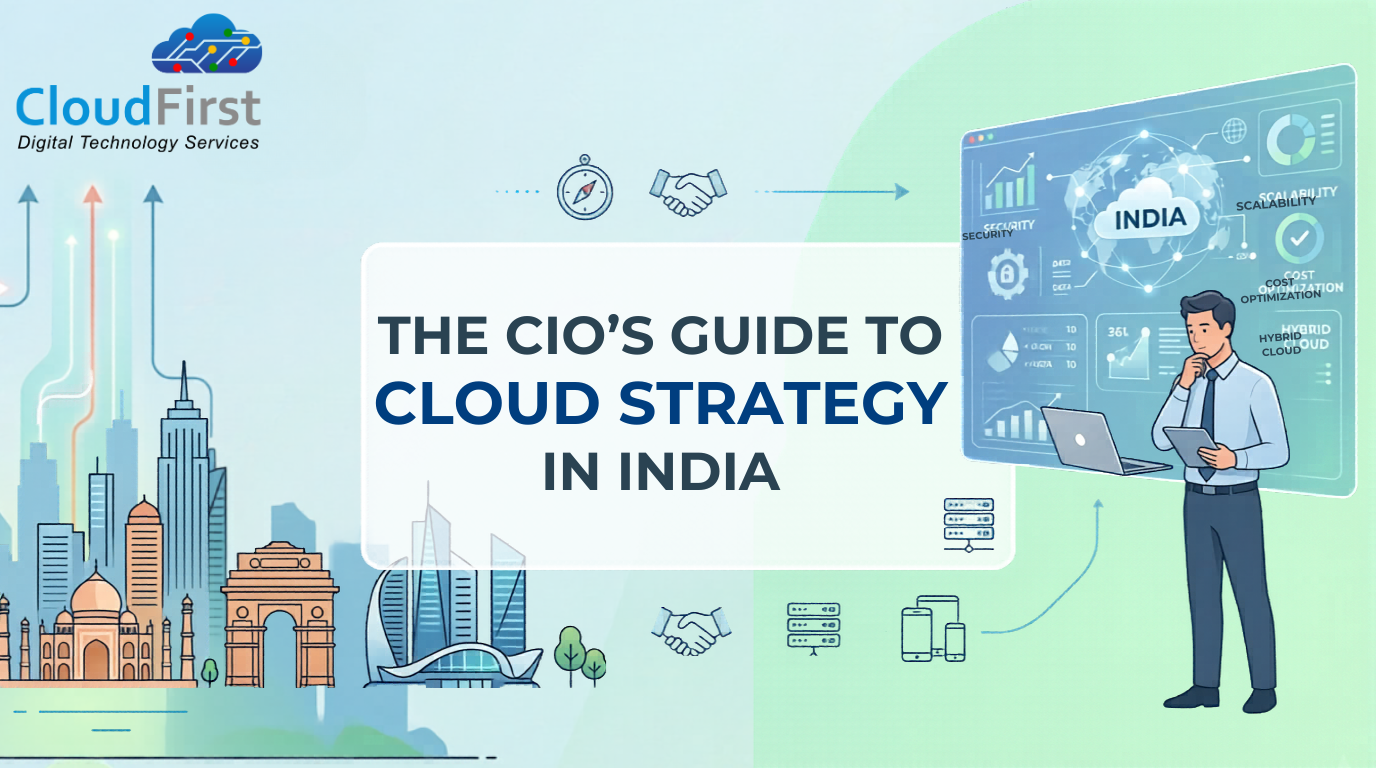
This guide is written for the CIO, CTO, or VP IT who wants a clear, actionable view of where to invest, what to prioritise, and what risks to manage between now and 2028. It is organised around five tracks — Cost and FinOps, Security and Compliance, AI and Modernisation, Infrastructure and DR, and Talent and Organisation — across a three-phase horizon: Stabilise (2026), Optimise (2027), and Scale (2028).
Where Indian enterprises actually stand in 2026
Before planning the next three years, it helps to be honest about the starting position.
India now has four major cloud regions — AWS Mumbai, AWS Hyderabad, Azure Pune, and GCP Mumbai. Data localisation is no longer a credible reason to delay cloud adoption. But the maturity gap between what enterprises have deployed and how well they govern, secure, and operate those deployments is wide.
The most common patterns we see across Indian enterprise IT teams:
Lift-and-shift with unresolved technical debt. Workloads moved to cloud but not re-architected. The cost of running them is higher than on-premise was, and the flexibility benefits of cloud haven’t materialised.
Shadow IT proliferation. Business units bypassed IT to spin up SaaS and cloud resources directly. Many CIOs are discovering they have three or four times more cloud spend than the official budget reflects.
Compliance awareness without compliance readiness. Most teams know the DPDP Act exists and that CERT-In issued updated directions. Very few have completed a formal gap assessment, mapped their data flows, or tested their incident response procedures.
AI pilots with no path to production. Boards are asking for AI. Teams have run POCs. Almost none of those POCs have become production workloads with proper data governance, cost controls, or MLOps pipelines.
If two or three of these sound familiar, the three-year roadmap below is designed specifically for where you are.
The three-phase roadmap
Phase 1 — Stabilise (2026)
The goal in 2026 is not to move fast. It is to build the foundations that make everything else possible. Most Indian enterprises that are struggling with cloud costs, compliance exposure, or governance gaps are paying the price for skipping this phase the first time around.
What to do in 2026:
Get complete visibility over your cloud spend before committing to any new investments. This means tagging every resource, mapping spend to business units, and producing a baseline report that shows where money is going and what it is delivering. You cannot optimise what you cannot see.
Commission a DPDP Act gap assessment now. The Act is in force, and enforcement timelines are real. The gap assessment should identify which personal data you are storing, where it lives, whether consent mechanisms exist, and what your breach notification process looks like. This is not a six-month project — a focused team can complete it in six to eight weeks if properly resourced.
Fix IAM before anything else in security. Overprivileged accounts, unused roles, and missing MFA are the entry point for the majority of cloud security incidents. An IAM audit costs relatively little and closes a disproportionate amount of risk.
Establish your Cloud Centre of Excellence structure. Even if it starts as three or four people with a clear mandate, having a CCoE means cloud decisions get made consistently rather than independently by each business unit.
Phase 2 — Optimise (2027)
With visibility and foundations in place, 2027 is where the financial and operational returns start to materialise.
What to do in 2027:
Make your Reserved Instance and Savings Plans commitments. Most Indian enterprises are running too much compute on on-demand pricing. Once you have 12 months of usage data from 2026, you will have enough signal to commit confidently. A well-executed commitment strategy typically delivers 30 to 45 percent cost reduction on eligible workloads — meaningful at any scale.
Implement a chargeback or showback model. This is the step that changes cloud cost behaviour across the organisation. When business units see their cloud consumption in their own P&L, consumption patterns change. Start with showback (visibility without financial accountability) if your organisation is not ready for full chargeback, and move to chargeback within 12 months.
Run your first live DR failover test. This will be uncomfortable. Most Indian enterprises have a documented DR plan but have never actually executed a failover in a realistic scenario. Run it anyway. The failure modes you find in a planned test are far less expensive than the ones you find during an actual incident.
Deploy Cloud Security Posture Management tooling. Manual security reviews do not scale. CSPM tools give you continuous visibility into misconfigurations, policy violations, and compliance drift. At this stage, you should also be implementing Zero Trust principles — starting with network segmentation and privileged access controls.
Phase 3 — Scale (2028)
By 2028, enterprises that executed Phases 1 and 2 properly will be in a position to move aggressively on AI, multi-cloud resilience, and platform engineering. Those that didn’t will still be firefighting cost and compliance.
What to do in 2028:
Move your best-performing AI pilots into production with proper MLOps infrastructure. This means model versioning, data lineage tracking, drift monitoring, and cost guardrails. Inference on managed services like AWS Bedrock, Azure OpenAI, or Vertex AI is the right starting point for most enterprises — building and training your own foundation models is rarely justified at this stage.
Build for resilience across regions. AWS Hyderabad gives Indian enterprises a second AWS region entirely within India — a significant change from the position three years ago. Multi-region active-passive architectures are now achievable without data sovereignty compromises. Design for this.
Invest in Platform Engineering. The CCoE that you built in 2026 should evolve into a team that builds and operates an Internal Developer Platform — self-service infrastructure, standardised deployment pipelines, and guardrails that make it fast and safe for engineering teams to build on cloud. This is what cloud-native engineering culture actually looks like in practice.
The five priority tracks in detail
Track 1: Cost and FinOps
Cloud cost in India is not primarily a negotiation problem. It is a visibility and accountability problem. Most enterprises are not overpaying their cloud providers — they are over-consuming without understanding why, and they lack the internal structures to change that behaviour.
The FinOps maturity model has three stages: Inform, Optimise, and Operate. Most Indian enterprises are still in Inform — they can produce a monthly cloud bill but cannot tell you which team, product, or application drove which portion of it.
Getting to Optimise requires three things: complete resource tagging, tooling that maps spend to owners, and a governance process that reviews anomalies. Getting to Operate requires cultural change — cloud cost becomes a first-class engineering concern, not just a finance review item.
Practical starting point: Mandate 100% tagging coverage as a prerequisite for any new cloud resource provisioning. Block untagged resource creation at the infrastructure policy level. This alone changes behaviour within 60 days.
Track 2: Security and Compliance
The compliance landscape for Indian enterprises in 2026 is more demanding than it has ever been, and it is still evolving.
DPDP Act 2023 establishes obligations around the collection, processing, and storage of personal data of Indian citizens. Penalties for violations are significant. The key practical obligations are: maintaining a lawful basis for data processing, providing clear notice to data principals, honouring erasure requests, and reporting breaches to the Data Protection Board within the prescribed timeline. Cloud teams need to map every service that stores personal data and confirm it has appropriate controls.
CERT-In directions require organisations to report cybersecurity incidents within six hours of detection, maintain logs for 180 days, and ensure VPN and cloud infrastructure logs are retained and accessible. Many Indian enterprises are not yet compliant with the logging retention requirements.
RBI, SEBI, and IRDAI each have sector-specific cloud guidelines that govern how BFSI enterprises use public cloud. Common themes: data localisation for sensitive financial data, mandatory DR testing, vendor concentration risk assessments, and approval requirements for certain cloud deployments.
Practical starting point: The shared responsibility model is the most misunderstood concept in cloud security among Indian enterprise teams. Run a half-day workshop with your IT and security leadership that maps specifically what your cloud provider covers and what you are responsible for. The gaps are almost always in the “you are responsible” column.
Track 3: AI and Modernisation
The honest picture on enterprise AI in India in 2026: the enthusiasm is real, the board pressure is real, and the organisational readiness is not yet there in most enterprises.
The most common mistake is treating AI as a technology project rather than a data and process project. Before you can get meaningful value from AI on cloud, you need clean data pipelines, clear ownership of data assets, and business processes that are well-defined enough to benefit from automation. Many enterprises are discovering this only after spending on AI tooling that sits unused because the underlying data infrastructure isn’t ready.
What actually works at this stage: targeted inference use cases on managed AI services. Document summarisation, code assistance for internal development teams, intelligent search over internal knowledge bases, and customer service augmentation are all areas where Indian enterprises are seeing real productivity gains without requiring custom model development.
What to avoid: building your own LLMs, running large-scale fine-tuning jobs without a clear ROI case, and deploying AI in production without audit trails or governance frameworks.
Practical starting point: Pick two or three high-frequency internal workflows — processes that consume significant human time and have relatively structured inputs. Run a 90-day pilot using a managed AI service with a defined success metric. Use that learning to build your MLOps practice before scaling.
Track 4: Infrastructure and DR
AWS Mumbai (ap-south-1) remains the primary region for the majority of Indian enterprise workloads, and for most use cases it remains the right default. AWS Hyderabad (ap-south-2), launched in late 2022 and now fully mature, has changed the DR architecture conversation significantly.
Previously, enterprises requiring data residency within India had limited options for a geographically diverse secondary region. Hyderabad changes that. A Mumbai primary with Hyderabad secondary gives you meaningful geographic separation — approximately 570 kilometres — while keeping all data within Indian jurisdiction. For regulated industries with strict data localisation requirements, this is now the recommended baseline architecture.
On DR more broadly: the gap between documented DR and tested DR is the single biggest infrastructure risk in most Indian enterprise environments. Having a runbook is not the same as having a DR capability. Regulators — particularly RBI for BFSI — are increasingly asking for evidence of tested failovers, not just documented plans.
Practical starting point: Define your RTO and RPO requirements for each Tier 1 application. Map those requirements to your current architecture. For most enterprises, this exercise will immediately surface three or four applications where the documented recovery capability does not actually meet the stated requirement. Fix those before worrying about the rest.
Track 5: Talent and Organisation
The structural answer for cloud governance in most Indian enterprises is a Cloud Centre of Excellence. The CCoE sits between IT leadership and delivery teams — it sets standards, manages the cloud platform, owns vendor relationships, and builds the internal capability that lets engineering teams move fast without creating governance problems.
What a well-functioning CCoE looks like in practice: a team of four to eight people (depending on enterprise size) with a clear mandate from the CIO, ownership of cloud architecture standards, a catalogue of approved services and patterns, and a defined process for exceptions. Critically, the CCoE should be an enabler, not a gatekeeper. Teams that turn their CCoE into an approval bottleneck defeat the purpose.
On certifications: AWS Solutions Architect, AWS Security Specialty, and Microsoft Azure Administrator are the three most valuable certifications for Indian cloud teams right now. They are also the credentials that make engineers most poachable. Build retention into your certification investment — clear career paths, compensation reviews tied to cloud skills, and internal recognition for cloud expertise.
Practical starting point: If you don’t have a CCoE, start by identifying two or three people who are already functioning as informal cloud authorities in your organisation. Give them a formal mandate, a small budget, and 90 days to produce a Cloud Architecture Standards document. That document becomes the CCoE’s first deliverable and its reason to exist.
The five risks you must manage
1. Compliance enforcement is not theoretical anymore
The DPDP Act is in force. CERT-In’s updated directions are being enforced. BFSI regulators have issued cloud guidelines with teeth. The window for treating compliance as a future concern has closed. A data breach in 2026 that exposes non-compliance with DPDP obligations creates both regulatory and reputational risk at a scale Indian enterprises have not previously faced.
2. AI workload costs are unpredictable without governance
Inference costs on managed AI services can spike dramatically with usage growth. Training and fine-tuning jobs can consume GPU compute budgets in hours rather than days. Enterprises deploying AI without cost guardrails, usage policies, and FinOps controls are creating a new category of budget risk that finance teams are not yet equipped to manage.
3. Vendor concentration is a negotiation and resilience risk
Single-cloud dependence reduces your negotiating leverage at contract renewal and creates a single point of failure for your digital operations. Multi-cloud strategy is genuinely complex to execute, but the answer is not to ignore the risk — it is to design for portability at the architecture level even if you are not actively multi-cloud today.
4. Losing your CCoE lead is a strategic setback
The cloud-skilled engineer, and particularly the architect or team lead who has built deep institutional knowledge of your environment, is one of the most valuable and most poachable people in your organisation. Their departure creates a capability gap that takes 12 to 18 months to recover from. Retention strategy for this profile needs to sit at the CIO level, not the HR level.
5. AI governance gaps create legal and reputational exposure
Deploying AI in customer-facing workflows without audit trails, explainability, or human oversight creates risk that most Indian enterprises have not yet fully assessed. Boards and regulators are beginning to ask questions. Getting ahead of this with a governance framework now is far easier than retrofitting it after an incident.
What good looks like in 2028
The cloud-mature Indian enterprise in 2028 looks like this:
Real-time visibility into cloud spend with accountability sitting inside business units, not just in IT. Savings Plans commitments that reflect actual workload patterns. A FinOps culture where engineers think about cost as naturally as they think about performance.
A security and compliance posture that is continuously monitored, not annually audited. DPDP obligations that are understood, documented, and testable. Incident response that has been practiced, not just planned.
A portfolio of AI use cases in production — not pilots, not POCs, but running workflows delivering measurable productivity gains. An MLOps practice that can onboard a new use case without starting from scratch.
DR that is tested quarterly, meets regulatory RTO and RPO requirements, and leverages both AWS Mumbai and Hyderabad for resilience within Indian jurisdiction.
A CCoE with certified engineers, an internal developer platform that lets teams self-serve infrastructure safely, and a seat at the strategy table when the business makes technology decisions.
None of this is out of reach for Indian enterprises over a three-year horizon. But it requires making deliberate choices about where to invest — and accepting that building foundations properly in 2026 is worth more than chasing the next capability before the last one is stable.
Where to start
If this roadmap describes where you want to be but you are not sure where you are today, the most useful first step is a cloud strategy assessment — an honest benchmark of your current posture across cost, security, infrastructure, AI readiness, and talent against the standards appropriate for your industry and scale.
CloudFirst works with Indian enterprises across all five of these tracks. To understand where your cloud strategy stands and build a prioritised roadmap for 2026–2028, speak to our team – https://cloudfirst.in/contact-sales.php
Published by CloudFirst | Cloud Strategy | India Enterprise | 2026